
Artist
grace
Tompkins

Individual Works

The Matriarchal Archive

from the flordia gardens

The Velveteen Rabbit Series

Portrait of The Velveteen Rabbit

slivers of the self
ARTIST STATEMENT
My work considers the perception of others and the perception of self. I engage with ideas about memory, ethics of care, relationship dynamics, and empathy. As a highly empathetic person, I have always been incredibly sensitive to the experiences and emotions of others. My early exposure to death and life’s fleeting nature led to a fear of losing what I loved, and a compulsion to preserve my memory of these things. From a young age, my camera became the way I tried to capture what slipped away: a loved one’s smile, places that no longer exist, and the intimate exchange between an old friend. As we grow as individuals and move through the world, there are always parts of our lives—the people in it and ourselves leave behind. These things inform who we are. I consider how memory can be fragmented and fluid. Our memories and experiences inform how we engage with others in a social framework, even if the actuality of what occurred resembles something different.
I have begun to research and engage with the history of the photographic archive as both a tool for representation and collection. I am interested in how the archive has been used to define collective memory and public perception. Systems of power have historically used the photographic archive to exclude and present a version of reality that has been altered. In our current social context, the notion of photography as evidence and the use of artificial intelligence have created further disconnect between public consciousness and information. In my work, I’m interested in both utilizing the photographic as a representation of reality and subverting it; presenting images that exist between the real and the unreliable, much like how our perception and memories inform us. This is developed in a question of two directions in my art and research practice. How, as an artist, can I develop an intervention of the archive’s use of social control and also inform my viewers of the influence photography has in our lives and memories?
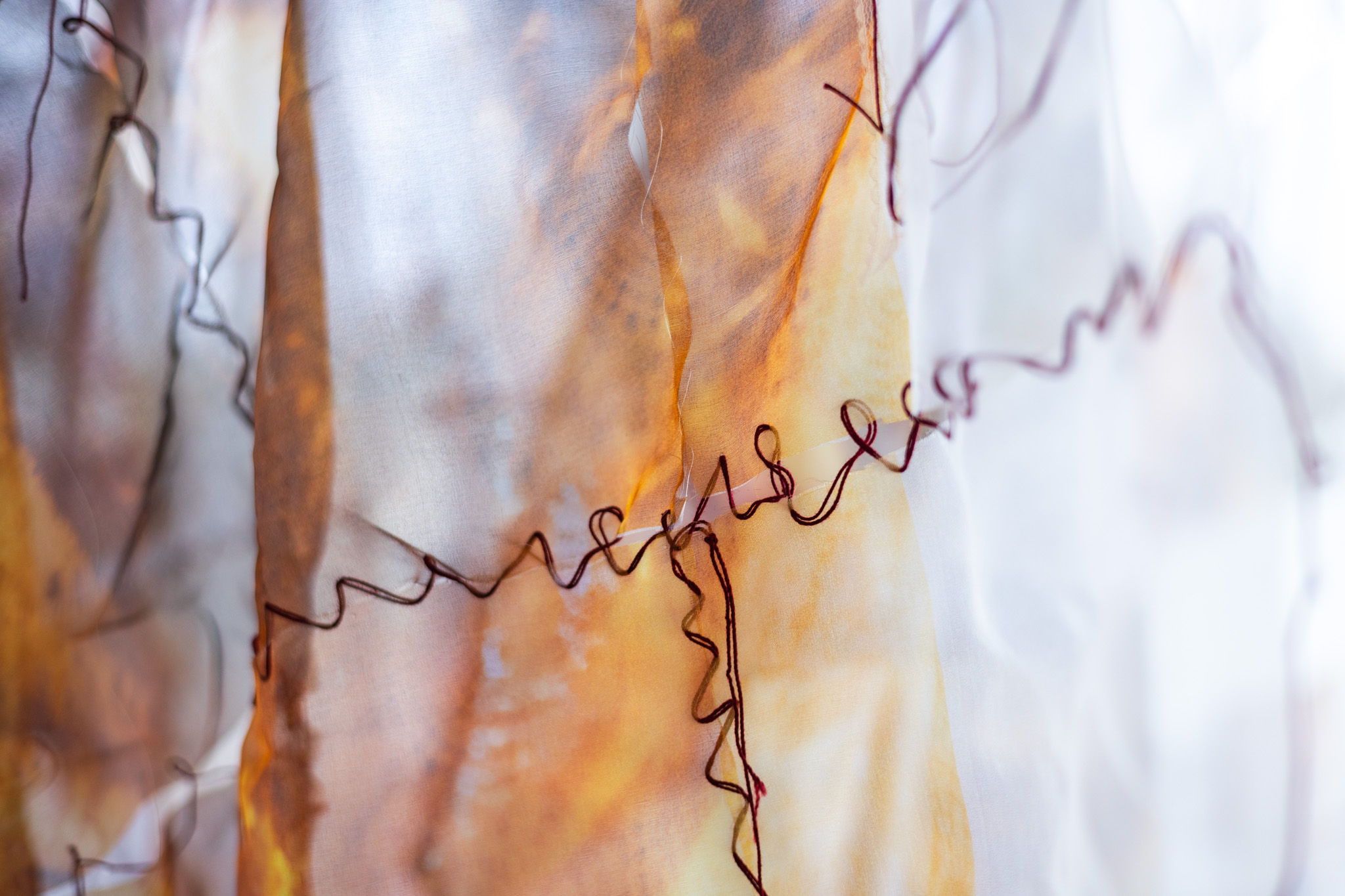
In my practice, I utilize digital and analogue photography, and incorporate textiles, video, and multimedia installation. I have long employed portrait photography to document people and their surroundings, utilizing methods of environmental portraiture and self-portraiture. My work with digital photography has often expanded beyond inkjet printing on paper to include unconventional outputs such as printed fabrics and video projection. My work operates within the framework of photographic capture but presents itself sculpturally. I am driven by a desire to present the photograph in ways that expand beyond its frame and into physical space. In my analogue work, cyanotype processing allows me to capture objects in a way that has direct contact with their surface. My large-scale installations act as immersive, interactive narratives and recreations of memories in a three-dimensional space. For example, the installations within my series The Velveteen Rabbit (2024) transform physical spaces into an immersive stage set, in which viewers are invited to explore every detail. Handwritten journal entries and personal belongings are left to be found by viewers.. Found objects alongside soft fabrics and trailing threads come together to become intimate sanctums and invitations for reflection of the viewer to consider community and those around them more deeply. My most recent work, The portrait of The Velveteen Rabbit (2025), considers the self through a fractured, shifting portrait, marking a shift in my practice from representing these experiences in the physical realm to something more ephemeral and fragmented. In this work, fabric becomes flesh, threaded together to form a large, disembodied portrait. As the world relies more on the digital, I feel a desire to create work that reflects the tangible. Creating these works attempts to memorialize something that once was while also engaging digital culture.
My interest in textiles also extends beyond these formal concerns to consider their conceptual significance as a historically feminine art form; I engage with the usage of textiles such as quilts and tapestries as a form of preserving information, much like the archive. Presented in my work, fraying threads and ripped seams unravel their integrity, and stitching is used as a restoration of its form. My identity as a woman and how my empathetic tendencies positioned me to consider others’ needs above my own also informs my work. I am interested in how gendered expectations of care that are placed on women underpin relationship dynamics. I think about empathy and emotional labor, specifically in the context of women and the domestic setting. As a woman raised in southern culture and tradition, I find myself attempting to stretch and unravel expectations of gender performance placed on myself and those around me. Expectations of women to be polite, quiet caregivers attempt to strip away our own needs and desires. I am interested in confronting the loss of community that occurs in the digital age and establishing care in these spaces. I endeavor for my work to become spaces for reflection that extend beyond the personal; I hope my work resonates on the individual level but also encourages viewers to consider the communal experiences of those around them. Through the lens of the personal alongside shared experiences, my practice considers the fleeting expressions of grief, joy, and all that pulses through our finite hearts.
Inquiries
Gracetfineart@gmail.com